Monday, October 11, 2010

Barley Flakes Uncooked

Maastricht (Netherlands)

Maastricht is a city in southeastern Netherlands, capital of the province Limburg along the border with Belgium. It is located on both sides of the river Meuse. Maastricht's name comes from 'ad Mosamad Trajectum' (Step of the Meuse "in Latin), referring to bridge the Romans under the reign of Julius Caesar.
For years, it has played the role of the oldest Dutch city with Nijmegen. Nijmegen was the first city in which laws were applied Roman city. Maastricht was the first city to medieval law, a legal system that has evolved to the current system. Roman sources mention
a Celtic settlement (probably inhabited by Eburones) at the site on which to build the bridge. Other sources point to a Celtic settlement on a river near Wyck, a district of the city located on the east side of the river Meuse.
Maastricht is famous because it was signed the treaty that bears his name, which gave birth to the European Union. Offers a special atmosphere and different from the rest of the country due to the strong influence from neighboring countries.
»» Point of interest:
Along the narrow streets of Maastricht are admiring stunning elegant houses of the sixteenth and seventeenth centuries, beautifully decorated with colorful painted windows crammed with flowers. There are still many Roman buildings in the city and towers, walls and doors of medieval walls.
"On the Maas river rises St. Servaas Bridge , a robust yet elegant construction that dates back to 1280.
"Stadhuis : The City of Maastricht (1659-1664) is one of the most important architect Pieter Post (1608-1669). In it stands a majestic double staircase and the tower from 1684 that contains a carillon with 49 bells, used every Saturday, a beautiful tapestry interesting interior, stucco and chimneys and the imposing lobby with its painted ceiling and mold OCTA.
"Vrijhof : The heart of the city both geographically and socially. A meeting place surrounded by trees and terraces, which is why his nickname is 'Living Maastricht'. One of the striking buildings near the plaza is " Generaalshuis " today is a theater that was built in 1809 as a neoclassical palace for General Dibbets managed to keep Maastricht in the Netherlands.
On the west side of the Plaza Hotel San Servaaskerk , the oldest church in the Netherlands. The construction began around 1000, on the site where Saint Servatius was called the basilica. It contains a priceless collection of sacred artifacts in his treasure chamber, and these include objects used in public worship, shrines, paintings, statues, old cloth and ivory carvings.
San Servaaskerk Next is the Sint-Janskerk (Iglesia de San Juan), an impressive Gothic building, the tower stands fine, reddish throughout the plaza. The church began in the fourteenth century and completed in the fifteenth, from adding an apse and the graceful tower over 70 meters tall with a square base and octagonal then shot higher. Within the Church there is St. John still rocks on the floor that served as headstones for graves of important people who they are buried in underground tombs. This practice was also common in other Dutch churches. Still have some stones inscribed with the names and, sometimes, the professions of the people, but few contain dates. In 1633 he became a Protestant church, which shows some of the existing religious duality in the Netherlands.
Almost as impressive as the San Servaaskerk, is the Church of Our Lady (Onze Lieve Vrouwekerk ). Construction started around 1000. The most impressive is the western wall. After completion, the construction continued and was completed in the tenth century the nave and transept. The choir was added in the twelfth century crypt atop a XI century on the eastern side. The church has a crypt and paths sixteenth-century cloister, and retains excellent medieval liturgical objects and reliquaries. Located on the plaza of the same name, Onze-Lieve-Vrouwep lein.
" Walls. In the southern part of the city still retain large chunks of the ancient walls surrounding the city. Within the defensive enclosures, the most characteristic feature is Helpoort or 'Gate of Hell. " Corresponds to the medieval walls and its construction is 1229.
»» Museums:
"Bonnefantenmuseum (Avenue Ceramique, 250) [ official Web ] [ Learn more , English] [Video ]: The Museum Bonnefanten ('Good Children's Museum ") is the leading museum of old masters and contemporary art located in the province of Limburg. Built by Italian architect Aldo Rossi, the impressive domed museum is one of the hallmarks of Maastricht. An abundance of natural light and use of natural materials gives the building its unique appearance.
The museum houses two major collections. On the one hand, medieval art funds eighteenth century, which are divided into three groups: medieval sculpture, paintings from the southern Netherlands and Italian masters before 1650 and the century XV and XVI Germanic painting and sculpture. Pieter Brueghel the Younger is the highlight of this collection. Furthermore, the contemporary art collection contains works of an international group of artists. Only five works have a permanent location in this section
" Natuurhistorisch Museum (Natural History Museum) (De Bosquetplein 6.7) [official website ]. Located in a XVII century convent, with a collection of geology, flora and fossils from the territory of Limburg. One of the main issues are the remains of a huge mosasaur. The museum houses more than 550,000 natural objects and the sample includes more than 11,000 species.
" Spaans Gouvernement Museum (Vrijthof 18) [official website ]: The former residence of the Dukes of Brabant, the sixteenth century, where he was Felipe II. It contains furniture, porcelain and paintings of interest.
"Derlon Cellar Museum (Onze Lieve Vrouweplein 6): home to Roman ruins dating from the II, III and IV. The museum itself is located in the basement of the hotel Derlon, in the underground.
»» Parks:
On the south side of the city's "green belt" of parks, City Park, Faliezusters, Nolens Park, and Park Aldenhofpark Waldeck. Many parks are part of the old fortresses of the city. There is also a wide variety of European trees, fountains and ponds for domestic ducks.
Vaeshartels Kasteel Park has ancient trees. Surrounding the castle and was designed by architect Belgian landscape uitecto Gindre in 1852.
»» Other landscapes and spaces:
" Dinghuis : A high-rise building and gothic style, the fifteenth century, where once stood the Court of Justice. On the ground floor of the building is now located the tourist information office.
"Hoge Fronten (also known as Linie van du Moulin) a military stronghold of the XVI to XVII.
"Kazematten a series of tunnels built under the Hoge Front.
" Markt, a newly renovated plaza, which houses a market three times a week.
"South of the city is the hill of San Pietersberg , which has an ancient fort built between 1701 and 1702, with a network of caves in it. These caves were formed after the excavations were made to build houses, as they are formed from limestone. Were used as hideouts during the Second World War. Later, the marl was used by the local cement company. During the process of extracting ore, built an artificial hill called "D'n Observant."
"Statue of D'Artagnan in Aldenhofpark.
'Shopping Streets : Stokstraatkwartier, Grote Staat, Kleine Staat and market Entre Deux.
"" Bibliography and sources: tourist brochures of the city of Maastricht " Maastricht (Wikipedia) " Maastricht (Holland America)
" " Links: " Maastricht (official website) " Maastricht (Tourist Office) (with page in English) "Tourism in Maastricht (Holland.com) " Maastricht Guide (guide) " Maastricht (Traveling Amsterdam) " Maastricht Treaty " Maastricht, the city of dealers (El Diario Montanes) " Maastricht (Blog 'Travel around the world')


Mount And 1.003 Trainer

Zaanse Schans (Netherlands)

only 8 miles from Amsterdam, near Zaandam Zaanse Schans is , calm and quiet between mills and canals. A beautiful Dutch village that seems almost made for tourism for its perfection. Because is the perfect recreation of what we've always thought it was a typical Dutch village.
Zaanse Schans is
is an outdoor museum that shows visitors what life in the region 'de Zaan' 150 years ago. This resort, created in 1960, offers main attraction featuring original houses with beautiful facades and historic shipyard crafts demonstrations clogs Although the mills are particularly critical to attracting thousands of visitors. De Zaan was probably the first industrial state that existed in the world.
More than 800 mills have reached the Zaan region, but today in this small village have focused a few from various points in the area, in order not to lose the historical tradition that keeps the place.
" " Some history:
Zaanstreek takes forever seniority on the banks of the river Zaan. This important waterway in the province of North Holland originated as a natural drainage area surrounding the peat swamp. It is believed that "industrial Zaanstreek" with its many windmills is the oldest industrial area in Europe. Industrial progress can be easily seen in Zaanse Schans with windmills in the foreground and modern factories in the skyline.
" " Zaanse Schans:
The houses in this small town are wooden houses, with walls painted in colors, usually green or black. Among them, small bridges that connect individual and allow us to save the channels of small canals that surround them.
Most buildings were relocated to other areas Zaanstreek in 1960 and 1970 due to urban development that were under the threat of annihilation. They moved to the Zaanse Schans, the exact location in 1574 Diederik van Sonoy, a governor at the service of William of Orange, with the help of the local population, up trenches to stop the advance of the English army.
" revolutionized the application of the crankshaft industrial development of windmills in the Netherlands. Cornelis Corneliszoon of Uitgeest, an early inventor of the Golden Age of the principle applied for the first time in 1594 in a wooden windmill sawing. This process was so successful that from then sawing logs by hand became a thing of the past and the windmills Holland helped change geographically and culturally.
Of the thousands of industrial windmills built in the past along the river Zaan currently only hold twelve, six of which can be found, restored, in the Zaanse Schans: the mustard mill (De Heisman), the latest oil mills there (De zoeken and De Bonte Hen), grinder dedicated to grinding materials to create pigments for paints, originating in 1646 (De Kat) and sawmills mills used for grinding tropical timber and logs (De Gekroonde Poelenburg and Het Jonge Schaap .)
addition to the six wind mills, two other small mills in the Zaanse Schans, De Windhond and Weidemolen De Hadel. The preservation and conservation of windmills in the rest of Zaanstreek is because Zaansche Windmill Society, founded in 1925 by professor and artist Frans Mars. Provided that, due to the age of the windmills and the introduction of steam engines, would lose their importance economic and thus disappear from the area and an important element of culture Zaanse be lost forever. The company had the initial objective of establishing the Mill Museum in 1928.
" Among the museums highlights of the first grocery store Albert Heijn . Albert Heijn, grandfather and founder of the powerful empire of supermarkets Ahold took over the small grocery store his parents in 1887. The original interior of the museum is testimony to the considerable changes and developments over the past century. Also worth the bakery museum Duyvekater in Gecroonde of the museum Zaanse Noorderhuis and Verkade, but are open daily throughout the year. In addition, there are workshops and the workshop traditional Dutch clogs or wooden shoes, pewter casting, the manufacture of cheese and the shipyard.
A typical visit is the museum of clocks, Klokkenmuseum , which also shows how to do them and teach some models that are unique in the world.
farms, cheese factories workshops and give a more traditional flavor to this place, as if it were seventeenth century. In summer, cruise ships can be discovered by the levees surrounding.
"" Bibliography and sources: " Amsterdam Area (Visual Guides El País Aguilar) " Zaanse Schans (Holland America)
"" Links: "Zaanse Schans (Web oficial) » Zaanse Schaans (Visitar Amsterdam)


Monday, October 4, 2010

Best Clothes Colour For Brown Skin

22

Lately I've been obsessed with hotcakes / pancakes. I like to eat for breakfast, lunch or dinner. What I love about pancakes is that they are as white boxes where you can create new flavors, you can use your creativity and put a chocolate chip banana Tantita berries with lemon peel, peanut butter and strawberries ... and more ! My favorite ingredient in pancakes are the blackberries, I love how awake the whole dish and it does not so heavy, yet very filling.


For you use your favorite ingredients is important to have a basic pancake recipe that always work, and that is the recipe I share with you today.

Hotcakes:
1 1 / 3 cups flour 2 teaspoons
of
baking powder 1 / 4 cups sugar
1 / 2 teaspoon salt 1 cup
soymilk
1 / 3 cups water (mineral water has to be, complete with gas)
1 teaspoon vanilla 1 tablespoon oil

In a bowl combine the flour, baking powder, sugar, and salt. Add remaining ingredients and mix. Something very important when you're making pancakes is not to mix more, what works for me is counting to 10, maybe you'll see all edges and not very mixed, but that's okay.

Heat a skillet over medium heat and add oil little bit, just so nothing is sticking. You can make pancakes as large or as small as you like, I like them with 1 / 4 cup of the mixture. As soon as you put in the pan add your extra ingredients such as blueberries, strawberries, bananas, chocolate, etc.. You can also leave them as they are and yet tasty treats. When you see bubbles on the edges of the pancake is time to turn.


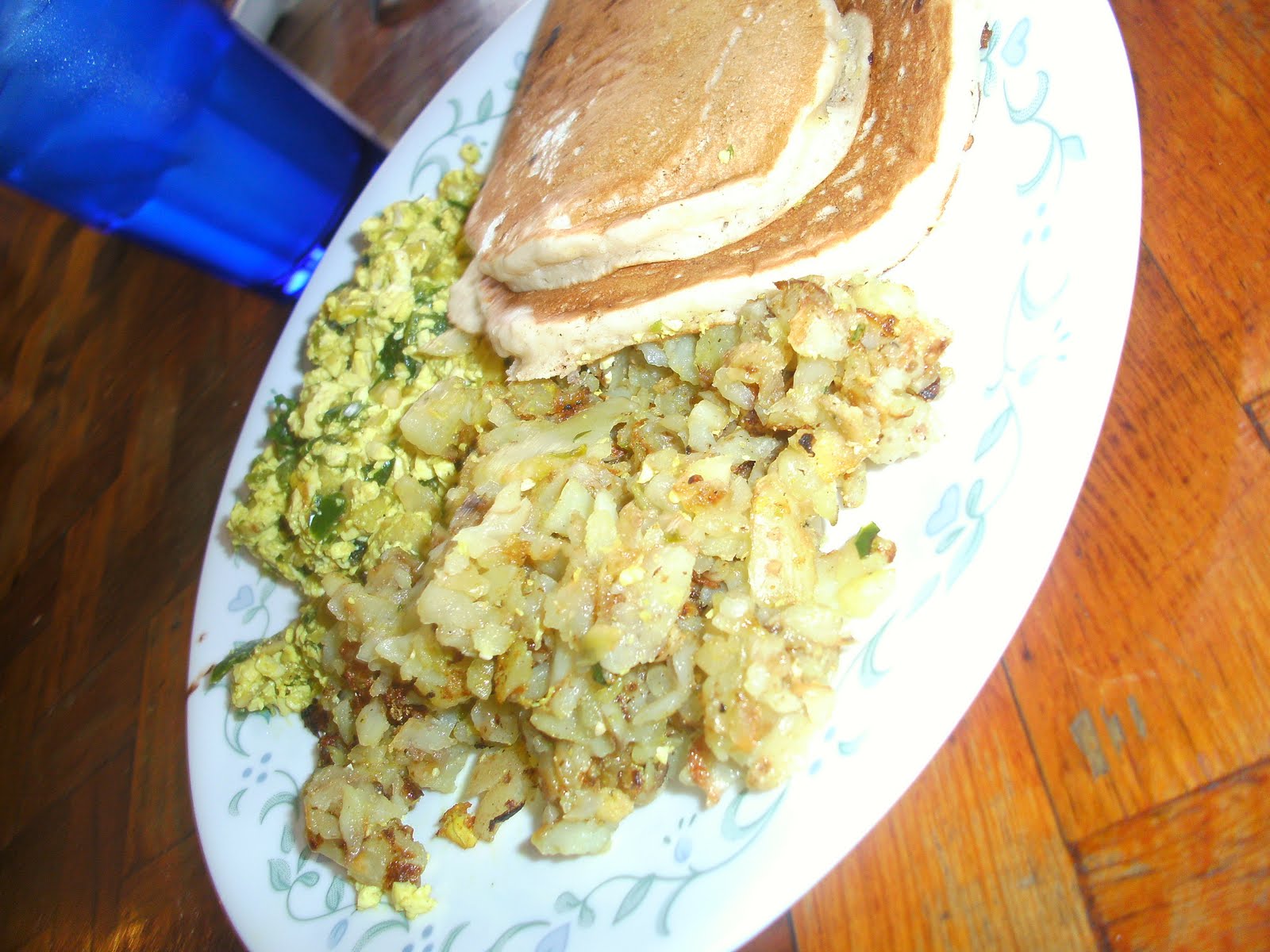
On the plate you see in the picture there "eggs" scrambled tofu, hash browns and pancakes.

Here are more recipes for pancakes. Hotcakes

oat and corn Hotcakes

Sunday, October 3, 2010

Easy Rail Rider Changing Station

Vienna: Schönbrunn Palace / Austria

El Palacio de Schönbrunn ( Schloss Schönbrunn ) y su gran parque se extienden al final de la Wienzeile, al suroeste de Viena, en el elegante distrito de Hietzing. Antigua residencia de verano de los Habsburgo, se erige majestuoso en un área donde anteriormente se erigieron hasta tres castillos, que fueron devastados en sendos incendios y asedios a Viena, the last in 1683. It was originally a hunting lodge (Katterburg) which was acquired in 1559 by Emperor Maximilian II. Emperor Matthias II after 1612 resided in the castle that his brother Rudolf II ordered its reconstruction in 1605, after a raid in Hungary. During a hunt, Matthias II found in the woods a beautiful fountain ('Schöne Brunnen') to give his name all over the place: Schönbrunn.
Napoleon installed in the palace his headquarters between 1805 and 1809, being seen also in many events in modern history: from the sessions of the Congress of Vienna in 1814 and 1815 to Kennedy talks Kruchev 1961.
The uniqueness of the complex and its conservation status led UNESCO to declare it a World Heritage Site in 1996.

Following the second siege of Vienna (1683), Emperor Leopold I commissioned Johann Bernhard Fischer von Erlach the Elder build a palace for his son Joseph, the future Joseph I. The Austrian architect, but trained in Italy, modeled after Versailles. Its construction was only process underway in the years 1695 and 1696, on the right bank of the river Wien, on a second project, simplified by Fischer von Erlach himself, and finished between 1713 and 1737. This original structure, only Palace Chapel (Schlosskapelle) and the Staircase Blue (Blaue Stiege) with a fresco by Sebastiano Ricci.
Charles VI showed no particular interest in Schönbrunn will be your daughter, Maria Teresa, who became the summer residence palace of the Habsburgs would retain until the end of the monarchy in 1918. During the reign of Maria Theresa proceeded to a significant expansion of the Palace (1744-1749) directed by Nikolaus von Pacassi, who had also worked for the imperial family in Hofburg. Most of the interior has its origins in this time and is one of the few existing samples of so-called Austrian rococo. By 1765 Johann Ferdinand
Hetzendorf von Hohenberg, which is considered as a representative of the first stage of classicism, takes over as the construction of the palace. His most significant is the Gloriette supplementing the large castle park. Between 1817 and 1819 Johann Aman holds a unification and simplification of the facade according to the dictates of classicism. From that time yellow color is also so typical of the facade, which until the twentieth century would be one of the identities of the Habsburg monarchy, for all official buildings were painted with the same color.
"Schönbrunn Outdoors:
Haupttor The main entrance flanked by two obelisks, Schosstrasse Schönenbrunner opens at the end of which a wrought iron gate gives access to the rococo Ehrenhof , large courtyard, closed at the sides by eighteenth-century low-rise buildings in the center and chaired by two fountains decorated with allegorical figures of 1776.
The strict symmetry of the architecture perfectly complements the gardens ( Schönbrunner Schlosspark ) filled with fountains and statues, surrounded by vegetation and trails. The gardens, designed in 1705 and 1706 by Jean Trehet, are formed by a labyrinth of complicated travel, obelisks, lakes and roundabouts.
The Schlosspark is separate from the two long buildings gardens, Kammergarten right and left Kronprinzengarten. The Blumenparterre, the center continues to Neptunbrunnen (Neptune fountain) in 1780, decorated with statues of Franz Anton Zauner and surrounded by trees. To the right of the source is the labyrinth of Irrgarten. Nearby are the Najade-Brunnen (sources of Naiads) WC built by Beyer in 1771, and the Schooner Bruner (Beautiful Fountain), which gives its name to the residence. Here is the sen Egyptian obelisk (Obelisk) and Ruine Romanische , both work Hetzendorf. In front of the high hill is the Gloriette , designed by Ferdinand von Hohenberg, built in 1775. Behind is the Fasangarten.
The gardens were completed in the eastern sector Botanischer Garten, botanical garden created in 1753 by A. von Steckhoven as Dutch garden, the Palmenhaus (Palm House), which acts as a tropical greenhouse (1883), the Tiergarten , Schönbrunn Zoo founded in 1752 by Franz Stephan of Lorraine, husband of Maria Theresa, octagonal-shaped pavilion, and the former Sonnenuhrhaus (Butterfly House).
"Interior spaces of Schönbrunn: Schönbrunn
Imperial Apartments has 40 rooms in total and 1441, which testify to the splendor of the everyday life of the court at the time of Empress Maria Theresa. The interiors are a true treasure with frescoes, trompe I'oeil paintings, marquetry, lacquer, stucco and mirrors, tapestries, marble and glass.
rococo style used by Nikolaus Pacassi dominates the decor in the official salons. Highlight the blanks, sometimes decorated with gold ornamentation. The rooms are sometimes very sumptuous, as Millionenzimmer , fig lined wood and adorned with Persian miniatures, and also there are very simple, as the rooms occupied by Franz Joseph and Empress Elisabeth. The Grand Gallery
was used for the imperial banquet, and since 1994, hosts official receptions. The Circular Chinese Room was used by Maria Teresa to hold private conversations with his chancellor. Other important facilities include the Blue Chinese Room, rather than abdication of Charles I in 1918, that of Old Lacquer where Teresa lived to be a widow, the Great Hall Rosa, which is named by the scenery Switzerland and northern Italy, painted by Joseph II.


" Other areas of Schönbrunn:
Ehrenhof To the right is the Schosstheater (Palace Theatre), cosntruido between 1774 and 1759 as Pascassi draft, amended in 1767 by JF Hetzendorf.
The Wagenburg, Chariots Museum, where vehicles are set out in the eighteenth and nineteenth centuries, many of which belonged to members of the royal family and famous people of the Empire. In the beginning was the site of the Winter Riding School. As the impressive imperial hearse, black (Schwarzer Leichenwagen des Wiener Hofes), built between 1876 and 1877 in neo-baroque and used at the funeral of Empress Elizabeth, Francis Joseph and the former Empress Lita (1989, the red hearse (Roter Leichenwagen), with which were taken to the crypt of the Capuchin not reigning members of the House of Habsburg, and the great Imperial Chariot.
» Bibliography: » Austria (Total Guide Anaya Touring Club) »Vienna (Visual Guides El País Aguilar)
» Links: " Schönbrunn (official website) " Schönbrunn (Wikipedia) " Schönbrunn (Three trips a day) " » Information:
XIII, Schönbrunner Schlossstrasse
U4: Schönbrunn
U4 underground station, tram 60, tram station
Hietzing 10, 58, bus 10A: Schloss Schönbrunn station