Thursday, January 6, 2011

Depressing Chords On Piano

Brussels: Quartier Royal / Belgium

Palais Royal (Brussels)
The Quartier Royal traditionally welcomed the leaders and nobility of Brussels. They chose the area called Hill Coudenberg other times because the air was purer than in the Lower City. Here was erected in the XV century Coudenberg Palace, residence of the Dukes of Brabant and Renaissance rulers.
In 1731 the palace was destroyed in just six hours by a fire. Slowly rebuilt during the eighteenth and nineteenth centuries, the four new buildings and much of the park is designed in neoclassical style, on the election of Charles of Lorraine.
Today, the Quartier Royal transmits a quiet elegance, with some interesting eighteenth-century buildings that frame the Parc de Bruxelles and the Palais Royal, the Palais de Academy, Charles de Lorraine Palais, the Palais de la Nation and the superb Royal Place, bounded all the endless Rue Royal (Koningstraat), Rue Ducale (Hertogstraat), Rue de la Loi (Wetstraat) and the Place de Palais (Palaizenplain).
Palais Royal (Brussels)
»Buildings and places of interest:
" Palais Royal (Place des Palais): The most important of all the palaces that rise around the Parc de Bruxelles. It was built in the style of Louis XVI in the 1820 on the site of ancient palace Coudenberg. The work continued under Leopold II (ruled from 1865 to 1909) and completed much of the exterior facade. During the twentieth century interior improvements were incorporated and restored older areas such as those of Maquet between 1904 and 1912. Is the official residence of the royal family of Belgium whose flag, when hoisted on the roof, indicating the presence of the king in his country.
Upon entering the building a monumental staircase is found dominated by a beautiful dome. The Throne Room , dating from 1872, is one of the most beautiful parts of the Palais Royal. Decorated grandly and has huge columns with pilasters, 11 large chandeliers and 28 chandeliers. The Hall of Mirrors is also interesting for its original roof and grandeur. Reminds the Hall of Mirrors at Versailles. Other sites that stand out are the Little White Room, which has portraits of the nineteenth century, large crystal chandeliers lit with candles and rococo furniture late eighteenth century, the Field Marshal room with a portrait of the first king of Belgium, Leopold I, an original copy of Winterhalter, 1823; the gallery, which presents the ceilings decorated with paintings of the late nineteenth century, representing the dawn, day and evening, and the Board Empire, the Goya or the lounge room Bleu.
St-Jacques-sur-Coudenberg in Place Royale (Brussels)
"Place Royale / Koningsplain : The square retains the influence of Carlos Enrique Lorenzo , governor of Brussels from 1749 to 1780, he rebuilt the place formerly occupied Coudenberg palace destroyed in the fire of 1731 in accordance with the prevailing style in Vienna, which he admired. Its beauty is due both to the harmony and uniformity of the eight surrounding neoclassical buildings, like the prospects can be seen on it. Barre and was built by Guimard between 1774 and 1780.
When the area was renovated, they left the burning ruins of the former palace and the space is organized in two excavations in 1995 plazas.Durante surfaced XV century remains belonging to the Aula Magna of the old palace hall where the emperor abdicated English Carlos V in favor of his son Philip II. This palace was build under the dukes of Brabant in the early thirteenth century and was favored under the reign of the dukes of Burgundy, especially by Philip the Good. Here now stands the Archaeological Site Coudenberg (Palacio de Carlos V) [official website ].
At the heart of the beautiful plaza symmetrical stands the statue of Godfrey of Bouillon, Brabant soldier who fought in the first cross-Catholic and died in Palestine. It was made in 1848 by Eugène Simonis to replace the statue of Prince Charles Alexander of Lorraine, who had been cast in metal during the French Revolution.
"Église Saint-Jacques-sur-Coudenberg (Place Royale): This beautiful building is the latest in a series of churches that occupied this site. From the twelfth century there was a chapel that was replaced with another for use of the dukes of Brabant. He became ducal chapel when Coudenberg built the palace in the thirteenth century. The chapel was looted in 1579 during conflict between Catholics and Protestants and the 1731 fire that destroyed the palace was badly damaged and had to be demolished. The present church was built in compliance with the prevailing neoclassical style in the area. It was consecrated in 1787 and designed by Barré and Guimard, although during the French Revolution was used as the Temple of Law and Reason. In 1802 he returned to the Catholic Church. The dome was completed in 1849. The barrel hall and apse with its half-dome are studded with floral motifs in plaster. Inside are two large paintings of Jan Portaels to each side of the crossing, as well as a seat reserved for the royal family.
Parc de Bruxelles from Place de Palais (Brussels)
"Musée Belvue (Place des Palais 7): The Museum of Belgian Dynasty painting has a large collection, documents and other real objects depicting the history of the Belgian monarchy from the country's independence in 1830 until the present time. Since 1992, is headquartered in the former Bellevue Hotel, an eighteenth-century neoclassical building adjacent to the Palais Royale and built the palace in 1902. In 1998 included a permanent exhibition in honor of the late King Baudouin (reigned from 1951 to 1993), with official portraits and personal photographs.
" La Rue Royale runs from Quartier Royal to the botanical garden. When was stated its neoclassical architecture, but now, its most notable buildings are examples of Victorian or art nouveau. The Parc de Bruxelles occupied hunting grounds used in medieval times by the dukes of Brabant. It was renovated in the 1770s with fountains, sculptures and rides for the French and Austrian Barnabas Guimard Zinner, two geometric ponds with fountains, statues of the XVIII century and the Théatre du Parc at the northeast corner. In the Rue Ducale is located Palais Académie , built in 1823 as the residence of crown prince since 1876 headquarters of the Royal Academy of Belgium. In the Rue de la Loi is the Palais de la Nation , also the work of French architect Guimard Barnabas. It was built in 1783 and restored in 1883 after a fire. Since 1831 houses the two chambers of the Belgian Parliament: Deputies in the Senate right wing and left wing.
Old England-Musée Instrumental (Brussels)
"Musée Instrumental (Rue Montagne de la Cour 2) [official website ]: Old England occupies the building formerly owned by a department store, a jewel of art nouveau, built by Paul Saintenoy in 1899 with a very elaborate facade made entirely of glass and wrought iron. It is topped by a domed gazebo and a lateral tower. The collection of the Musee Instrumental, formerly at the Sablon, began in the nineteenth century, when the state purchased 80 old and exotic instruments. Doubled its funding in 1876 with the donation of King Leopold II of 97 Indian musical instruments that gave him a maharaja. In 1924 and had 3,300 pieces, and now over 6,000 wind instruments, string and keyboard from medieval times to the present. Among the major pieces features a collection of prototypes of the Belgian Adolphe Sax, inventor of the saxophone, miniviolines from street musicians and a full copy of the study of a violin maker.
'Palais des Beaux-Arts (Rue Ravenstein 23): art nouveau style, was built between 1922 and 1928 by Victor Horta, who had to review the proposal to six times the height of the building, located on a hillside not obstruct the view of the city since the Palais Royal. It hosts various cultural events of music, dance, theater, film and art in general. Here is located the National Orchestra of Belgium. It owes its existence to Henri Le Boeuf, a financial music lover who gave his name to the main auditorium.
also contains the Musee du Cinema, now known as Cinematek (Rue Baron Horta 9) [official website ], opened in 1962, with an interesting file and exhibitions. Classic movies are projected.
»Hôtel Ravenstein (Rue Ravenstein 3): For centuries it has been home to noble families, soldiers and officers of the court, and for the last 100 years is the headquarters of the Royal Society of Engineers. The building was erected in the fifteenth century, to Adolfo and Felipe Cleves-Ravenstein and acquired in 1896 by the city at that time used as storage obras de arte hasta su restauración en 1934. Es el último ejemplo que queda de una mansión de estilo borgoñón.
Palais de Charles de Lorraine (Bruselas)
» Palais de Charles de Lorraine (Place du Musée 1): Es poco lo que se conserva del edificio original del palacio de Carlos de Lorena, gobernador de la ciudad de Bruselas a mediados del siglo XVIII e importante mecenas de las artes, ya que el palacio fue saqueado por las tropas francesas en el año 1794. Los bajorrelieves de la parte alta de la escalera representan el aire, la tierra, el fuego y el agua; además reflect the interest in alchemy at Charles de Lorraine. The highlight is the floor in a star of 28 points of the circular room, each built with a different kind of Belgian marble. The grand staircase is decorated with statues of L. Delvaux (1770) and stucco and silks from Lyon.
"Musées Royaux des Beaux-Arts (Rue de la Regence 3) [official website ] [Learn more ]: Known collectively as Musées Royaux des Beaux-Arts, the Musée d'Art Ancien and the Musée d'Art Moderne is the most important of Brussels, specializing in fine arts. In these museums, adjacent to the Place Royale, displays objects from the two eras: ancient (XV to XVIII centuries) and modern (since the nineteenth century to the present). Housed in a neoclassical building by Alphonse Balat between 1784 and 1880, the Musée d'Art Ancien is the largest collection of dos.La understand the few valuables they left behind the French republican army, which stripped Brussels many of its treasures to bring to Paris. This collection was initially exhibited in the Palais de Charles de Lorraine and was swelled by some sponsors, donations and recovery of parts brought to France. The present gallery was opened in 1887. The Musée d'Art Ancien is famous for its magnificent art collection flamenco, the best in the world. They represented many old masters such as Van Dyck, Rubens, Pieter Bruegel the Elder and Hugo van der Goes.
Opened in 1984, the Musée d'Art Moderne has a unique provision: eight levels of the building are underground, but a skylight allows many of the works can be viewed with natural light filtering through from the Place du Musée. The top three floors are devoted to temporary exhibitions. The wide and varied collection is sorted cronológicamente.Están represented many famous artists of the twentieth century, from 1900 until today, but the most famous works are those of the Belgian surrealists like André Breton, René Magritte and Paul Delvaux.
" Magritte Museum (Place Royale) [official website ]: Opened in 2009, has a wonderful collection of 200 works of René Magritte (1898-1967), master of surrealism. Among the exhibits are 'The Return' (1940), 'Scheherazade' (1948) or 'The Empire of Light' (1954).
» Bibliography:" Brussels, Bruges, Ghent and Antwerp "(El País Aguilar Visual Guides)" 'Belgium and Luxembourg' (Total Guide Anaya Touring Club) »Brussels (Plano, guide) (Ediciones B)
»Links: " About Belgium »Brussels (Wikipedia)" Stad Brussel " Belgian Tourist Office: Brussels and Wallonia (in English) » Tourism Flanders

Thursday, December 30, 2010

Boxer Puppies For Sale In Illinois

Potsdam: Park Sanssouci / Germany

Park Sanssouci (Potsdam)
The extensive Park Sanssouci Potsdam (287 acres, 2 miles west of downtown) is one of the most beautiful palace complexes in Europe. The first building site was Schloss Sanssouci. In 1744 King Frederick the Great ordered the construction of a residence here, where he could live 'sans souci' ('no worries' in French which was spoken in the court.) It was built on the terraces of a vineyard by Georg Wenzeslaus of Knobelsdorff following the ideas and drawings of the king. This building is one of the most important works of German rococo architecture and houses, among other masterpieces by Watteau, Panini and Pesne.
Over time, the park was expanded considerably and were added to other palaces and pavilions, as the New Palace, the Orangery or the palace Charlottenhof.
»Buildings and places of interest:
" Schloss Sanssouci (Historisches Zur Mühle): The rococo palace was built between 1745 and 1747 by Georg Wenzeslaus of Knobelsdorff from some sketches of the same , Frederick II of Prussia. Knobelsdorff and Johann August Nahl, meanwhile, designed the interior. Jann Boumann, a Dutch architect, completed the project. 'Sanssouci' ('no preopcupaciones') was the appropriate name for a castle of such charm.
During the nineteenth century the palace became one of the residence of Frederick William IV of Prussia. It hired the architect Ludwig Persius to restore and expand the palace, and Ferdinand von Arnim to improve the city and in this way, the views from the palace. The Damenflügel, the west wing was added in 1840 to accommodate the ladies and gentlemen of the court. The Schlossküche (from the castle) can also be visited. In 1990, UNESCO declared the palace and gardens heritage of mankind [ Learn more at Wikipedia ].

Schloss Sanssouci (Potsdam)
"Neue Schloss Kammern (Historisches Zur Mühle, Lustgarten): The Neue Kammern (new units) Schloss Sanssouci bordering the west and to the east side Bildergalerie . The structure was built in 1747 as a greenhouse from a design by Georg Wenzeslaus of Knobelsdorff. The building, elegant Baroque style, has a nice roof, overhanging eaves. In 1777 was transformed into a guest house by order of Frederick the Great. Unger GC respected architect almost the entire exterior of the building and ordered units and four sumptuous elegant lounges inside. Rococo decoration, similar to other buildings and pavilions of Sanssouci, has remained.
Orangerie Schloss (Potsdam)
'Orangerie Schloss (Maulbeerallee, Nordisher Garten), the former royal palace for foreign guests. Italian Renaissance style and surmounted by a colonnade, the Orangerie was built for King between 1852 and 1860 by Friedrich August Stüler, and the final draft was based in part on levels of Ludwig Persius. Is inspired by the Sala Regia of the Vatican, and the rooms are grouped around Rafael room, wear replicas of works of the great Italian master. Hosted Tsar Nicholas and his wife, sister of Frederick William IV.
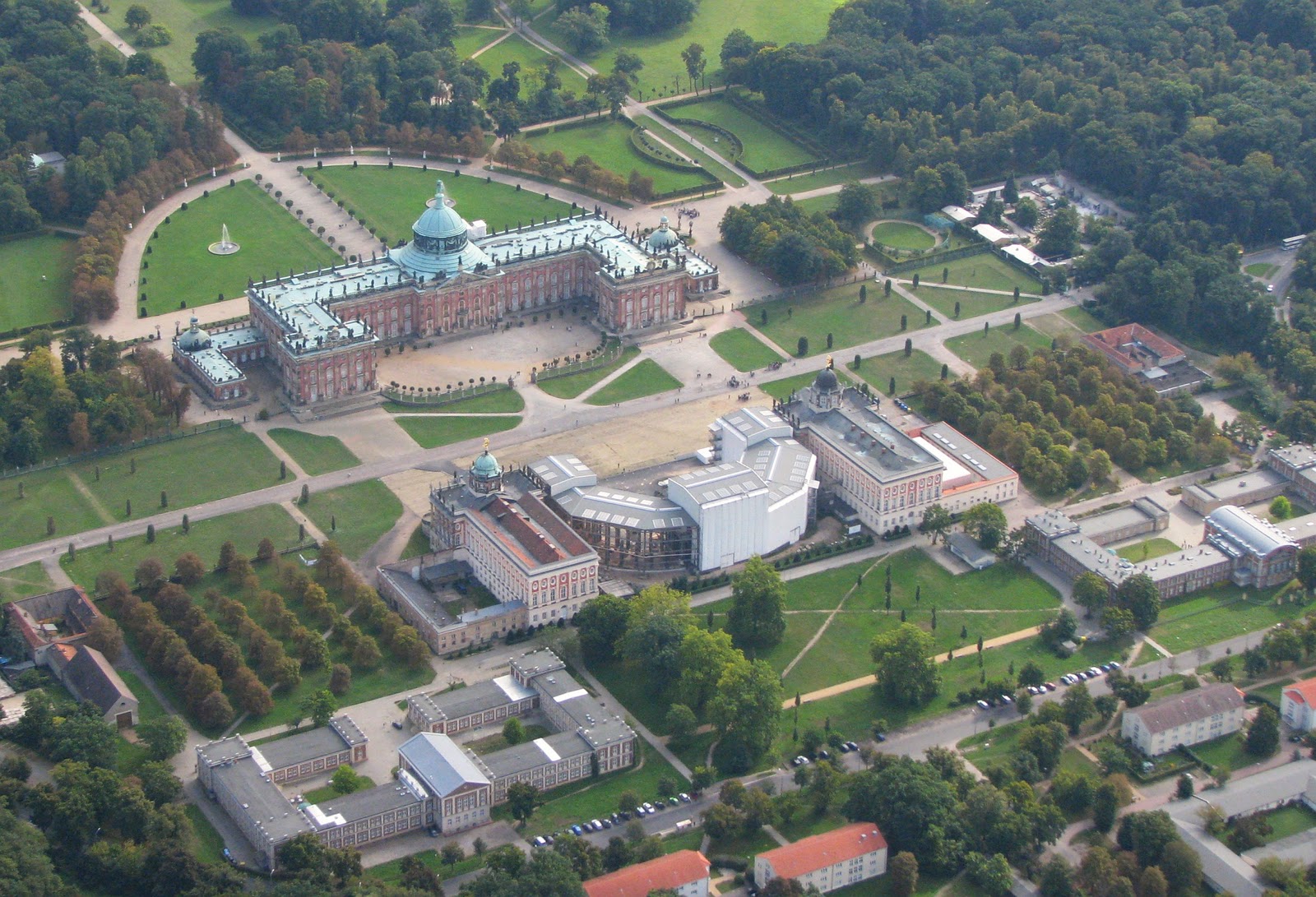
"Neues Palais (Am Neuen Palais): The imposing baroque structure located on the main avenue of the park is one of the most beautiful palaces in Germany. It was built between 1763 and 1769 to celebrate the end of the Seven Years' War, in which Prussia ended the centuries-old Austrian rule on German affairs. The project was designed by Georg Wenzeslaus of Knobelsdorff in 1750, but the works undertaken by Johann Gottfried Burying, Jean Laurent Geay and Carl von Gontard, had to be postponed until the end of war.
The vast structure with three wings and two plants is much greater than that of Sanssouci, with over 200 rooms and 400 statues as decoration. In the south wing are the offices of king and a small theater. He served as a guest house for many royal visitors.
Charlottenhoff Schloss (Potsdam)
"Schloss Charlottenhof (Geschwister-Scholl-Strasse, Park Charlottenhoff): This neo-classical palace is located in the southern end of Park Sanssouci, known as Park Charlottenhoff, and which owes its name to Charlotte von Gentzkow, former owner of the land on which the palace was built. The small one-story building was built in 1826-1829 in the style of a Roman villa for the heir to the throne, the future King Frederick William IV, by Karl Friedrich Schinkel. Some of the Pompeian-style frescoes on the walls are still standing. In addition, a collection of Italian engravings. Inside the room stands Humboldt. The adjoining garden care was designed by Peter Joseph Lenne.
"Chinesisches Teehaus (Ökonomiewig, Reshgarten): The China Tea House is a pavilion built in XVIII century style Chinese, in the fashion of the time. It was built between 1754 and 1756 from a design by Johann Gottfried Burying. The pavilion has a circular with a central main hall surrounded by three studies. Surrounding the flag golden ornaments such as columns and Chinese figures. Originally a tea room and dining, but today houses a collection of eighteenth century porcelain.
Römische Bäder (Potsdam)
"Römische Bäder (Lenne-Strasse, Park Charlottenhoff): Bathrooms Romans built on the shores of the lake by Karl Friedrich Schinkel and Ludwig Persius in 1829-1840, is a complex of buildings including a tea pavilion, a Renaissance-style villa and a Roman-style baths (which takes its name the entire complex). The gardener's house stands beside a small tower with asymmetric, built in the style of an Italian Renaissance villa. Behind, left, lies the old pavilion of temporary exhibitions baths. The pavilions are arranged around a garden.
»Bildergalerie (Historisches Zur Mühle): Located next to Schloss Sanssouci, the Bildergalerie exposed baroque paintings that belonged to Frederick the Great, as "The doubt of St. Thomas 'Caravaggio' and 'Death of Cleopatra' by Guido Reni, and works by Rubens and Van Dyck.
"Other spaces : Close is the Bildergalerie Friedenskirche , Neo-Romantic Church of Peace, inspired by the Basilica of San Clemente in Rome. Communs is an unusual style building, located next to the courtyard of the Neues Palais, which serves to accommodate the staff of the palace. The Lutsgarten (garden of pleasure) is a large park with several gardens near the Orangerie. The Temple of Friendship was built south of the main avenue of the park between 1768 and 1770 by Carl von Gontard in memory of the favorite sister of Frederick the Great, the Margravine Wilhelmina of Bayreuth. The building complements the Old Temple, which is located north of the avenue. The Drachenhaus (Dragon House) was built between 1770 and 1772 in the Chinoiserie style on the northern edge of Sanssouci Park.
"" Bibliography: »Germany (Visual Guides El País Aguilar)» Deutschland (Baedecker, Allianz Reiseführer)
»Links: " Potsdam (Wikipedia) " Potsdam (official website)" Potsdam (of Germany) " Potsdam Tourismus " Potsdam Park Sanssouci (Web official) "Potsdam Sanssouci

Monday, December 27, 2010

Certificate Of Rent Paid Mn

Potsdam (1) / Germany

Glienicke Bridge on the River Havel (Potsdam)
Potsdam, independent city close to Berlin, is also the capital of Brandenburg. The first reference to the city dating from 993, in 1317 would get its charter. The city flourished in the time of the electors and again in the eighteenth century. Potsdam was severely damaged in World War II, especially after the Allied bombing of the night from 14 to 15 April 1945. Potsdam
remains one of the most beautiful cities in Germany. The most popular attractions are Schloss Sanssouci, the majestic royal summer residence, the Neuer Garten (New Garden) in Marmorpalais (Marble Palace) and Cecilienhof, the old, the Russian colony Alexandrowka; the Babelsberg film studios the parks around Schloss Babelsberg.
Nikolaikirche and Fortuna Gate (Potsdam)
»Buildings and places of interest:
" the Old Market Square (Alter Mark ) is the historic center of Potsdam. For three centuries it was the place where it won the City Palace (Stadtschloss), a royal palace built in 1662. Under Frederick the Great, the palace became the winter residence of Prussian kings. The palace was badly damaged during the bombing of 1945 and the Communist authorities demolished it in 1961. In 2002 Fortuna Gate was rebuilt in its original historical position, marking the first step in rebuilding the palace. Old Market Square is dominated today by the leadership of Nikolai (Church of St. Nicholas), built in 1837 in neoclassical style late, the prettiest of Potsdam. The building, erected on the site of an earlier Baroque church destroyed by fire in 1795, was the last work of Karl Friedrich Schinkel, who designed the building but did not live to see it finished. What ended his disciples and Friedrich Ludwig Persius Stüler August.
The eastern part of the Market Square is dominated by the Alter Rathaus (Old Town Hall), built in 1755 by Dutch architect Johann Boumann (1706-1776). It has a feature circular tower, crowned with a golden Atlas holding the world on his shoulders. The long flag
Baroque ( Marstall ) than in the past housed the royal stables, the only building that remains of a royal residence. Data for 1714, and today houses a museum about the history and construction of the nearby Babelsberg film studio.
North of Old Market Square are the Französircherkirche (French Church) oval, built around 1750 by Boumann Huguenot community, and the Brandenburg Gate (built in 1770, and should not be confused with the Brandenburg Gate in Berlin).
"Viertel Holländisches : Another landmark of Potsdam is the Dutch Quarter, a complex of buildings that is unique in Europe, with about 150 houses built with red bricks in the Dutch style. It was built between 1733 and 1742 under the direction of Johann Boumann for Old Dutch craftsmen who had been invited to settle here by King Frederick William I in the early eighteenth century. The area comprising 134 houses with gables arranged in four groups and built with red brick and plaster ornamentation. Today, this area is one of the most visited neighborhoods Potsdam.
Alesandrowka (Potsdam)
" North of downtown is the Russian colony of Alexandrowka , a small enclave of Russian architecture (including a chapel Orthodox), built in 1826 under the direction of German architect Snethlage for a group of Russian immigrants. In 1999 the colony was declared a World Heritage Site by Unesco.
" East Alexandrowka the colony is a large park, Neuer Garten (New Garden), which was designed in 1786 in English style and consists of two palaces, one of them, the Cecilienhof Palace, was where the Potsdam Conference in July and August 1945. The Marmorpalais (Marble Palace) was built in 1789 in the style of Classicism. The residence
Cecilienhof played a brief but important role in history when in 1945 hosted the Potsdam Conference. The palace, built between 1914 and 1917, is the latest of all buildings of the Hohenzollern dynasty. Asymmetrical building is a large timber framed, with courtyards and uneven cuts, which was designed by Paul Schultze-Naumburg the style of an English manor. The palace continued
being the residence of the Hohenzollern after they lost the crown and the royal family remained in Potsdam until February 1945. Cecilienhof today houses a hotel. The beautiful and spacious park is open to the public, although the rooms used in the Potsdam Conference are closed.
Cecilienhof (Potsdam)
The Marmorpalais small palace, situated on the lake, owes its name to Silesia marble lining the facade and is a beautiful early exponent of neoclassical architecture. The main body project, commissioned Carl Gotthard Langhans by King Frederick William II, was executed between 1787 and 1791 by Carl von Gontard under the direction of Langhans.
" Another interesting area of \u200b\u200bPotsdam is Babelsberg, a suburb east of downtown, home to the UFA film studios (Babelsberg Studios), and an extensive park with some interesting buildings, including the Babelsberg Palace, a Gothic palace designed by Schinkel. The huge park film
Filmpark Babensberg (Grossbeerenstrasse) was established in the place where the first movie filmed in Germany. Since 1917, the study belonged to the Universum-Film-AG (UFA), producer of some of the films most famous of silent films, including 'Metropolis' by Fritz Lang and a few other of Greta Garbo. 'The Blue Angel, "with Marlene Dietrich, also was shot in Babelsberg, but later studies were used for Nazi propaganda film. Schloss Babenberg
The flamboyant is one of the finest works of Karl Friedrich Schinkel, who built it in 1833-1835 for Prince William (later Kaiser Wilhelm I). The irregular building, with numerous towers and viewpoints, reminds the English Gothic, Windsor Castle and Tudor style. It now houses the Museum of Prehistory.
" The Einsteinturm (Einstein Tower) (Albert-Einstein-Strasse) rose between 1920 and 1924 by architect Erich Mendelsohn in the top of Telegraphenberg. This tower is one of the finest exponents of German expressionist architecture. Its fantastic shapes show the dramatic effects that could be achieved with concrete. However, the high cost of formwork limited the use of this material to the first floor, the upper floors are of brick plastered with plaster.
"Schloss Sanssouci (in entrance in Potsdam 2 of this blog).
» Bibliography:" Germany (Visual Guides El País Aguilar) »Deutschland (Baedecker, Allianz Reiseführer)
»Links: " Potsdam (Wikipedia) "Potsdam (official website) " Potsdam (Destination Germany) "Potsdam Tourismus

Tuesday, December 14, 2010

What Do I Need For Dazzle

Paris Saint Germain-des-Prés / France

Saint-Germain-des-Prés in the Sixth Arrondissement of Paris, is a neighborhood around the old abbey church Saint-Germain-des-Prés. From the end
War Globally, the Faubourg Saint-Germain-des-Prés became one of the most prominent cultural and intellectual life of Paris. Philosophers, writers, actors and musicians mingled in the brasseries and night clubs (where bebop was invented and breweries where existentialist thought coexisted with American jazz. Music par excellence of Saint-Germain-des-Prés of the post- jazz reigned in so-called "caves" (caves) whose image and atmosphere characterized the Saint-Germain-des-Prés of the time. The most famous was Le Tabou, located at number 33, Rue Dauphine, where they played brothers Vian, and who visited a number of jazzmen Americans like Charlie Parker and Miles Davis.
Once past the turmoil of the post-Saint-Germain-des-Prés was also the favorite meeting place of the creators and actors of the 'nouvelle vague', in the late 50's and early 60's.
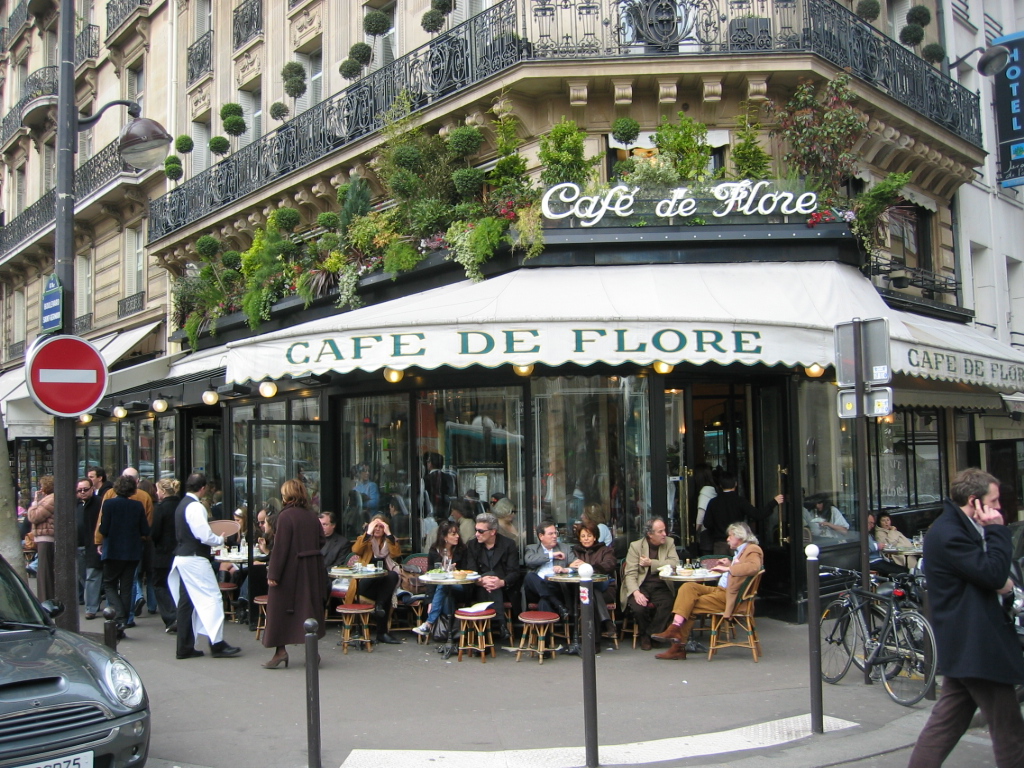
Now the area is more elegant than in times of Jean-Paul, Simone de Beaver, Juliette Greco or the directors of the same 'nouvelle vague', but still roam the place writers who enjoy the pleasure of sitting in Les Deux Magots, Café de Flore and other famous places. Seventeenth-century buildings remain, but there are obvious signs of change, such as antique shops, books and fashion.
»Buildings and places of interest:
" Boulevard St-Germain: The artery most famous Left Bank through three districts from the Ile St-Louis to the bridge Concorde. Its architecture is homogeneous because the Boulevard was another audacious achievements of urban planning of Baron Haussmann in the nineteenth century, but covers a wide range of styles from bohemian to bourgeois. From the east, past the Museum of Cluny and the Sorbonne. It is more lively from the Boulevard St-Michel to St-Germain-des-Prés, where tradition thrives cafes.
" Quai Voltaire: Voltaire Pier is now home to some of the most important antique Paris. Many famous people have lived in their beautiful houses of the eighteenth century, including Voltaire, at No. 27, and Richard Wagner, Jean Sibelius, Oscar Wilde at 19.
"Ecole Nationale Superieure des Beaux-Arts (14 rue Bonaparte) [official website ]: The main French school of Fine Arts is located at the corner of Rue Bonaparte and the Quai Malaquais. It occupies several buildings, among which the Palais des Etudes, XIX century. Many painters and architects in France and abroad have crossed the large courtyard, which contains a chapel seventeenth century, to study in the school workshops.
"Musée National Eugène Delacroix (6 rue de Füstenberg) [official website ]: The pre-eminent painter Eugène Delacroix lived and worked here from 1857 until his death in 1863. Here he painted "The Burial of Christ 'and' The Road to Calvary '(now in the museum). He also created splendid murals for the Chapel of the Holy Angels in the nearby church of St-Sulpice. The studio apartment overlooking the garden has a portrait of Georges Sand, and self-portraits and sketches by Delacroix.
'Eglise Saint-Germain des Prés (3 Place St-Germain-des-Prés): It is the oldest church in Paris, built in 542 as a basilica to house religious relics. Completed in 558 and consecrated by the Archbishop of Paris, Monsignor Germain, in the church are still the remains of his real backer, the Merovingian king Childebert I. He became a powerful Benedictine abbey. Was burned by Vikings in the ninth century, rebuilt in 1000 by Abbot Morard and enlarged in 1163 by Pope Alexander III. The French Revolution of 1789 turned it on in jail in punishment for two hundred Parisians who were killed there, and then gunpowder and munitions depot which caused much of it was destroyed by fire in 1794 destroyed their armor and much of its treasures, including his famous theological library. In the nineteenth century, architects Baltard Godde and restored it and gave it its current appearance.
It remains one of the three original towers, which is one of the oldest towers in France. The interior of the church shows an interesting mix of architectural styles with marble columns of the sixth century, a Gothic vault and Romanesque arches.
Here is buried the seventeenth century philosopher Descartes. In addition, there is a small drawing by Picasso that represent a woman's head. Placed in the corner of the square Saint-Germain at the corner of Rue Bonaparte, this picture is a tribute to the poet of the English painter friend Guillaume Apollinaire.
"Rue de l'Odeon : Opened in 1779 to improve access to the Odeon Theatre was the first street in Paris who disposed of sidewalks and still holds many eighteenth century houses. The bookstore of Sylvia Beach, the original Shakespeare & Company, was ranked number 12 between 1921 and 1940. It was a meeting place for writers like James Joyce, Ezra Pound and Ernest Hemingway.
»St-Sulpice (Place St-Sulpice): This great church was begun in 1646 and took over a century to complete. The second tallest church in the city, built in honor of St. Sulpice the Pious, which houses within it a system for determining astronomical equinoxes designed by Henry Sully.
Built on the foundations of an ancient XIII century Romanesque church, which suffered successive expansions until 1631. In 1646, Father Jean-Jacques Olier Paris ordered the construction of a new building, which extended for more than a century. The result was a plain building with two floors, with a west wing consists of two rows of elegant columns. The harmony of the towers only break of the extremes, which are not partners.
Shows simple facade with two floors of elegant columns. The arches of the windows flood the interior light. In a chapel on the right side there are murals of Eugene Delacroix as "Jacob fighting the angel 'and' Heliodorus driven from the temple '[ Learn more at Wikipedia ] .
"Other spaces in St-Germain-des-Prés : The Abbatial Palais was the residence of abbots from 1586 until the Revolution of 1789. The Rue de Buci was for centuries a major street and the scene of tennis matches royalty. Today it houses a lively market. The Café de Flore , local favorite Jean-Paul Sartre, Simone de Beauvoir and other French intellectuals. retains its art deco decor.
"" Bibliography: »France (Visual Guides El País Aguilar)
» Links and learn more: " Saint Germain-des-Prés (Wikipedia) " Eglise St-Germain-des-Prés "